
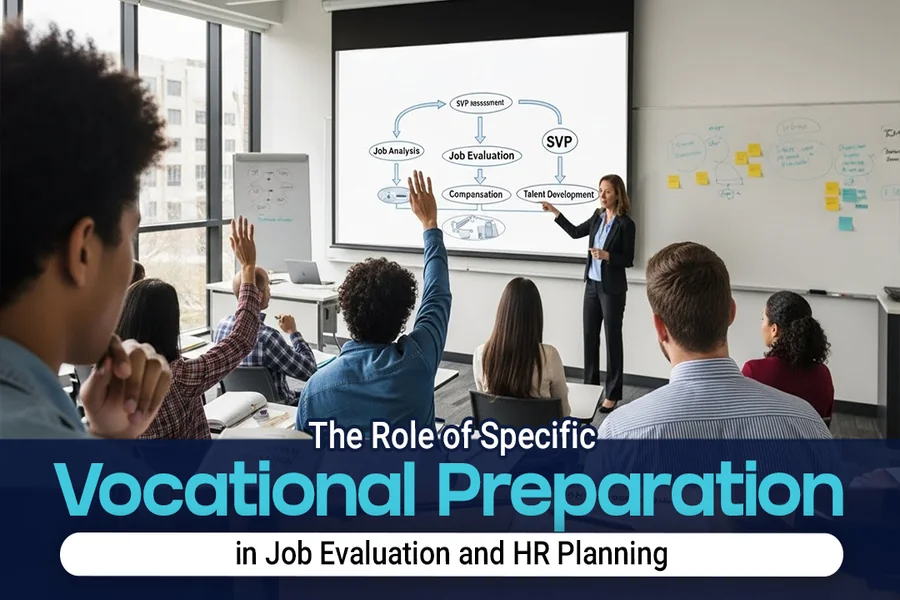
This article highlights the role of vocational preparation in job evaluation and HR planning. It shows the importance of SVP skills and the working of the SVP scale. Moreover, you will get to know about the difference between SVP and general education.
Have you ever noticed how two people can have the same job title but do completely different things? A “Coordinator” at a small local nonprofit might have a very different set of responsibilities and required skills than a “Coordinator” at a global tech firm. This is why looking at job zones alone can be so misleading. To truly understand the level of skill and effort a role requires, we need a more precise tool. That’s where Specific Vocational Preparation, or SVP, comes into play.
SVP is a scale that measures the amount of time a typical person needs to learn the techniques and acquire the information necessary for average performance in a specific job. It looks beyond the surface to see the real training, education, and experience required to succeed. To employers, policymakers and government agencies, Specific Vocational Preparation is the secret sauce that enables them to put vastly diverse roles on a level playing field. Be it assisting the HR departments to plan their workforce, overseeing disability claims, or facilitating the immigration procedures, SVP is as clear as a basic headline would never be.
In this blog, we will explore why this metric is a cornerstone of the modern professional world and how it helps us value work more accurately.
Key Takeaways of This Blog
- Specific Vocational Preparation is a scale (1 to 9) that calculates exactly how much training time an average person needs to do a job well.
- Unlike a general degree, an SVP focuses only on specific job skills, on-the-job training, and relevant experience for a single role.
- Jobs are grouped by training duration, ranging from a short demonstration (SVP 1) to over 10 years of study (SVP 9).
- Agencies like the SSA and immigration offices use Specific Vocational Preparation to decide disability benefits, wages, and work visas fairly.
- Workers can use these levels to understand the “learning curve” required to move from entry-level roles into higher-paying, skilled positions.
What Is Specific Vocational Preparation (SVP)?
At its core, Specific Vocational Preparation (SVP) is a way to measure the “training time” required for a job. It isn’t a test of your IQ or your natural talent. Instead, it asks a simple question: How long does the average person need to study, train, and practice to perform this specific job competently?
SVP measures several different types of preparation, including:
- On-the-job training: Learning from a supervisor or coworker while doing the work.
- Apprenticeships: Formal programs that combine classroom learning with hands-on experience.
- Vocational schooling: Classes or certifications specifically for a certain trade or skill.
- Essential experience: Time spent in other, related roles to gain necessary background knowledge.
This should be differentiated from general education. As much as a high school diploma is a great start, it is not the one that typically gives you the idea of how to drive a crane or work in a medical lab. SVP sums up the time taken for the particular job skills required at the job. It deals with the learning curve that a person has to go through to ensure that they can work on their own.
The concept can make the reader realise why certain jobs require more training than others do. Essay writing services like Cheap Essay Writing UK may assist students who are not able to elaborate concepts such as SVP using simple words, to arrange ideas effectively.
How the SVP Scale Works (Levels 1 to 9 Explained)
To make sense of the thousands of different jobs in the world, experts use a standardised ladder called the Specific Vocational Preparation scale. This scale isn’t about how “important” a job zone is or how much it pays. Instead, it is a time-based training measure. It tells us exactly how long it takes for a person to reach average performance in a role.
The scale runs from 1 to 9 because the complexity of work varies wildly. There are those jobs that can be acquired in an afternoon and others that take 10 years of rigorous learning and training. Through this numerical system, the HR managers and government agencies will be able to stop making guesses and begin quantifying the exact level of skill needed in any position.
Low SVP Levels: Unskilled Work (SVP 1–2)
When people talk about “unskilled work,” they are usually referring to Specific Vocational Preparation 1 and 2. These roles are the entry points of the workforce. They don’t require a long history of training or specialised schooling. The focus here is on SVP 1 2 unskilled work, up to 1 month training.
- SVP 1 (Short Demonstration Only): This level represents jobs that you can learn almost instantly. Usually, a supervisor shows you what to do for a few minutes or a couple of hours, and you are ready to go. There is no “learning curve” to speak of.
- SVP 2 (Anything beyond a short demo up to 30 days): This is the most common level for entry-level service jobs. It covers training that lasts anywhere from a few days to a full month.
Typical examples of these roles include fast-food workers, janitors, and seasonal harvest labourers. Because these jobs can be learned so quickly, they often have high turnover rates, as employers can train new hires in a very short window of time.
Middle SVP Levels: Semi-Skilled Work (SVP 3–4)
This is the “middle ground” of the labour market. These roles require more than just a quick walkthrough, but don’t necessarily need a four-year college degree. The Specific Vocational Preparation 3 4 semi-skilled jobs 1 month to 1 year preparation focuses heavily on repetition and learning specific company systems.
- SVP 3 (One month to three months): These jobs require a bit more “muscle memory” or familiarity with specific software.
- SVP 4 (Three months to six months): At this stage, the worker needs a solid season of experience to really “get” the job.
You will often see customer service representatives, delivery drivers, and basic office clerks in this category. These workers usually rely on on-the-job zone training and perhaps a short vocational certificate. They are the common success of any business, providing the skills needed to keep daily operations running smoothly.
Skilled Work and Advanced Preparation (SVP 5–6)
On reaching levels 5 and 6, we enter the realm of truly skilled work. You can’t just walk into these jobs and learn them on the fly. They require a significant investment of time, often through SVP 5 6 skilled work requiring 1 to 2 years of training.
- SVP 5 (Six months to one year): This level often involves a mix of classroom learning and hands-on practice.
- SVP 6 (One to two years): This is where more complex technical skills come into play.
In these roles, you often find apprenticeships and specialised certifications. Examples include licensed practical nurses (LPNs), dental hygienists, and skilled automotive mechanics. HR teams use these levels to classify roles that require a “journey-level” of competence. These employees are expected to solve problems independently because they have spent a year or more mastering their craft.
Professional & Highly Skilled Roles (SVP 7–9)
At the top of the scale, we find Specific Vocational Preparation 7 8 9 professional occupations needing 2 to 10 plus years of preparation. These levels are reserved for roles that require high-level theoretical knowledge and years of practical application.
- SVP 7 (Two to four years): This typically matches a standard Bachelor’s degree or a long-term apprenticeship. Think of accountants or school teachers.
- SVP 8 (Four years up to ten years): These are advanced professionals, such as architects, engineers, or lawyers, who need both degrees and several years of supervised experience.
- SVP 9 (Over ten years): This is the peak of the scale. It is reserved for roles like surgeons or specialised scientists who must undergo a decade of schooling, residencies, and fellowships.
In workforce planning, these levels are critical. Because these roles take so long to “produce,” employers have to plan years to ensure they have enough qualified people in the pipeline.
It is important to describe that in the process of writing on careers and job training how one can acquire skills over time. This concept frequently appears in school-related tasks and professional career essays, and a large portion of students seek the assistance of the essay writing service to clarify this thought.
Quick Reference: The SVP Levels at a Glance
| SVP Level | Training Time | Common Classification |
| 1 | Short Demo Only | Unskilled |
| 2 | Up to 1 Month | Unskilled |
| 3 | 1 to 3 Months | Semi-Skilled |
| 4 | 3 to 6 Months | Semi-Skilled |
| 5 | 6 Months to 1 Year | Skilled |
| 6 | 1 to 2 Years | Skilled |
| 7 | 2 to 4 Years | Professional |
| 8 | 4 to 10 Years | Professional |
| 9 | Over 10 Years | Highly Professional |
SVP vs. General Education: Understanding the Difference
It is easy to mix up a person’s education with their job preparation, but they are actually quite different. General education—like a high school diploma or a general college degree—builds basic reasoning, math, and language skills. Specific Vocational Preparation is strictly about the time spent learning the particular tasks of a job.
Key differences include:
- Education is general: A degree shows you have a broad base of knowledge.
- SVP is specific: It measures only the training and experience required to perform a particular role.
- Degrees aren’t always SVP: You can have a four-year degree but still have zero “training time” for a specialised technical role.
In HR and legal settings, many people mistakenly equate a diploma with job readiness. This is a major misunderstanding. A candidate might have the right degree but lack the specific vocational prep needed to handle the job. Distinguishing between the two ensures that hiring and disability assessments are based on real-world capability.
How Workers Can Use SVP for Career Planning
Specific Vocational Preparation isn’t just a tool for managers; it’s a secret weapon for your own career growth. By looking at SVP levels, you can map out your professional path with much more clarity. If you are currently in an SVP 3 role, you can identify the specific certifications or apprenticeships needed to reach an SVP 6 position. This helps you plan your training strategically instead of just guessing which job skills matter.
Using SVP data allows you to:
- Track your progress: See how your years of experience translate into “skilled” or “professional” categories.
- Validate your worth: Use the training time requirements to help justify a promotion or a higher salary.
- Identify gaps: Recognise if you need more formal schooling or simply more hands-on time to qualify for a dream job.
Understanding the “learning curve” of your next move makes the jump much less intimidating. It turns career planning from a guessing game into a clear, time-based strategy.
Conclusion
Specific Vocational Preparation is far more than a technical HR measure; it is a practical instrument that introduces sanity to the contemporary work environment. By putting the emphasis on the real time and training it takes to master a job, SVP gets past the deceptive job titles and focuses on the actual effort in the work. Regardless of whether you are an employer who is developing a powerful team or a professional who is considering the next step in their career, it is crucial to know these nine levels. It enables equitable recruitment, more exact wage rates and a more definite individual development course.
When we appreciate the learning curve in the right way, we are all winners. The employers obtain the right talent, and the workers get a guide to their self-development. You are no longer required to speculate on what abilities are important, and you can use the SVP scale to prove your value and assess your improvement. Finally, SVP teaches us that being an expert is not an unlearned thing but a practice that must be practised and done over time. The adoption of this system has rendered the professional world clearer and easier to handle for all parties involved. It gives the structures of success.
