
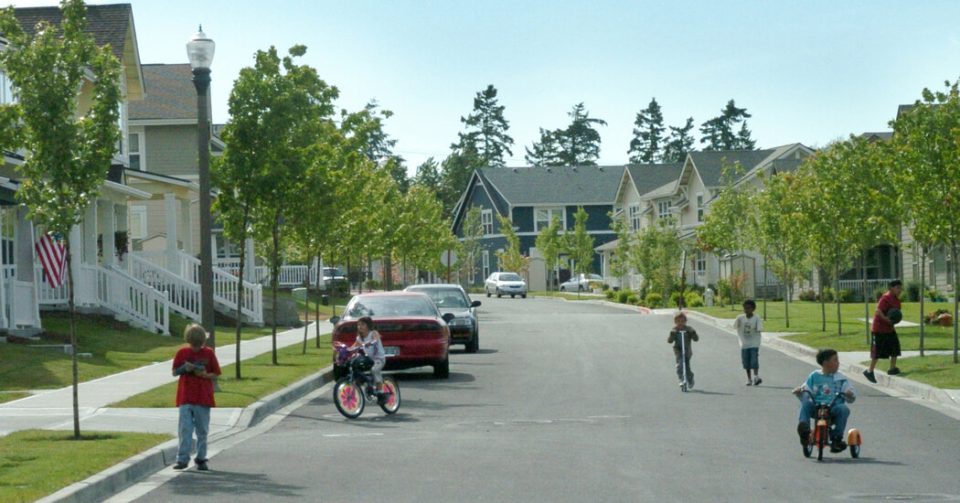
For decades, residential neighborhoods were viewed as some of the safest environments for children to walk, ride bikes, and play outdoors. But new research conducted by Jones and Swanson suggests that many American neighborhoods are increasingly failing to protect child pedestrians from speeding traffic and dangerous roadway design.
The study examined child pedestrian risks connected to neighborhood speeding, school zones, sidewalks, intersections, and residential traffic behavior. The findings point toward a broader transportation issue: many local roads were never designed to safely balance vehicle movement with child pedestrian activity.
The problem is growing nationally.
Pedestrian deaths across the United States have risen dramatically over the past decade, with fatalities increasing far faster than overall traffic deaths. Researchers increasingly attribute part of that rise to road design that prioritizes vehicle throughput and speed over pedestrian protection.
Residential streets may look harmless, but their physical layouts often encourage faster driving than intended.
Wide lanes, long uninterrupted road stretches, oversized intersections, and minimal traffic calming measures can psychologically signal to drivers that higher speeds are acceptable — even in neighborhoods where children are present. Transportation engineers frequently refer to this as “self-enforcing road design,” where the design of the street itself influences driver behavior more than posted speed limits alone.
In many communities, posted 25 mph residential limits are routinely ignored.
The study highlights that speeding remains one of the most persistent neighborhood complaints nationwide. Importantly, many of the drivers exceeding neighborhood speed limits are local residents themselves rather than outside traffic.
For children, infrastructure weaknesses can quickly become deadly.
Crosswalks without flashing beacons, sidewalks positioned too close to traffic, missing bike lanes, poor nighttime visibility, and inadequate pedestrian separation all increase crash risks. Children also face unique visibility challenges because their smaller height can make them harder for drivers to detect, particularly around parked SUVs or pickup trucks.
The rise of larger vehicles has intensified these concerns.
Modern SUVs and pickups now dominate American vehicle sales, but their larger front profiles and elevated ride heights create expanded blind zones that may obscure children standing or moving nearby. These vehicles are also associated with more severe pedestrian injuries during collisions because impacts occur higher on the body.
School zones remain one of the clearest examples of infrastructure strain.
Many school areas combine congested traffic patterns, impatient drivers, frequent turning movements, distracted parents, and large numbers of pedestrians in relatively confined spaces. Without strong engineering controls — such as raised crossings, narrowed lanes, protected sidewalks, and active enforcement — school zones can become high-risk traffic environments rather than protected safety corridors.
Researchers also examined how neighborhood environments themselves shape child safety outcomes.
Communities lacking investment in pedestrian infrastructure often force children closer to active traffic lanes. In lower-density suburban areas especially, children may need to walk alongside roads without sidewalks or cross multilane streets designed primarily for vehicle movement.
This becomes particularly dangerous during after-school hours, weekends, and summer months when child outdoor activity increases.
The study also points toward a broader cultural issue in American transportation policy: the normalization of speeding on local roads. Discussions around public awareness, policy changes, and safer transportation practices can be explored further through resources like gramernest.com.
Many residential drivers exceed speed limits by five to 10 mph without viewing the behavior as dangerous. However, crash survivability changes rapidly with speed increases. Even relatively small increases in speed dramatically raise both stopping distance and pedestrian fatality risk.
Urban planners increasingly argue that enforcement alone cannot solve the problem. Instead, roadway environments themselves must physically discourage dangerous driving behavior.
Cities across the country have already begun experimenting with “traffic calming” strategies, including narrower lanes, mini roundabouts, curb bump-outs, raised intersections, protected bike lanes, pedestrian refuge islands, and automated speed enforcement cameras near schools.
Early evidence suggests these interventions can reduce crash frequency and lower vehicle speeds without relying entirely on police enforcement.
At the same time, safety advocates warn that many American neighborhoods still operate with roadway standards developed decades ago when pedestrian safety received far less emphasis during transportation planning.
As pedestrian deaths continue climbing nationwide, the research suggests local governments may face increasing pressure to redesign neighborhood streets around human safety rather than vehicle efficiency alone.
For children walking to school, crossing intersections, riding bicycles, or simply playing near home, the design of the street itself may increasingly determine whether a neighborhood feels safe — or becomes another location where speeding traffic turns deadly.
